The Last Call for BMW\u2019s Electric Dreams
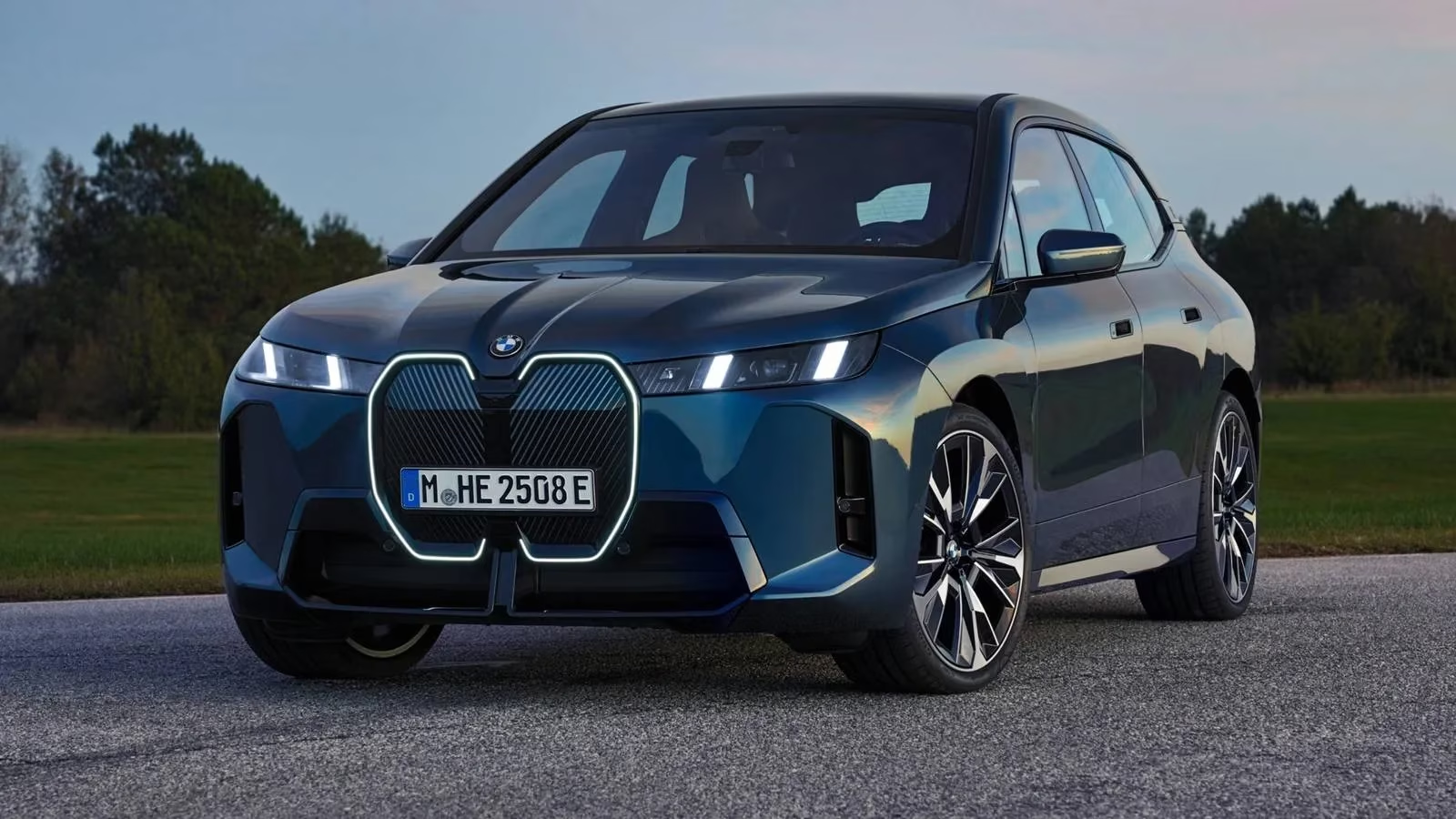
The morning coffee had barely touched Alex\u2019s lips when the notification nudged his phone. Another BMW bulletin, but this one stopped his scroll dead. In a terse letter to its American dealers, the Bavarian automaker had just declared it would slam the brakes on electric vehicle production come May. No restart date. No sugarcoating. Just\u2014poof\u2014an indefinite pause that left a whole lot of silence hanging in the air. For someone who had been eyeballing a sleek i4 for six months, the words felt less like a memo and more like a starting pistol.
The timing was strange, almost theatrical. BMW\u2019s EV sales had been flexing hard in the first quarter of 2026. According to official figures, the brand moved 13,538 battery-electric models between January and March, a 26% leap over the same period last year. The i4 sedan was the star of the show, roaring ahead with a 57% surge. Yet here was BMW, slapping a \u201cpause\u201d button while the applause was still ringing. The market, that unpredictable beast, had developed a nervous twitch.
\u201cPolitics and economics are staging their own drama,\u201d Alex muttered, scrolling deeper. The memo didn\u2019t spell out a single villain, and BMW\u2019s spokespeople had gone tight-lipped. But the ghosts were unhidden. A 25% tariff on imported cars, a legacy of the latest Trump administration, had turned every German-built i4, iX, i5, and i7 into a pricier proposition. Those four models, still shipped from factories in Dingolfing and Munich, now wore an invisible sticker shock. And if whispers in Washington proved true, the $7,500 federal clean vehicle tax credit might vanish before autumn. The incentive, which had cushioned over 1.2 million EV purchases last year, was living on borrowed time. Alex did the math: sticker price plus tariff minus credit\u2014if the credit evaporated, the bottom line would look like a bad joke.
\u201cHonestly, you know what they say about missing the boat?\u201d The sales advisor, a man named Marcus with twenty years of BMW chatter in his smile, leaned against a Mineral White i4 M50. His tone was half question, half dare. Alex had driven forty minutes to the dealership that same afternoon, propelled by a mix of anxiety and optimism. \u201cThe boat\u2019s not just leaving the dock. It\u2019s being mothballed for a while.\u201d
Marcus wasn\u2019t wrong. The dealer system had its own heartbeat, and it was racing. The bulletin also mentioned that the beloved 2 Series\u2014including the fire-breathing M2\u2014would see a price hike starting in May. But the EV halt was the headline. Without fresh supply rolling in after May, the existing inventory would start looking like collector\u2019s items. \u201cWe\u2019re already seeing a gentle run on i4s and iXs,\u201d Marcus admitted, his voice a conspiratorial murmur. \u201cPeople smell uncertainty, and they\u2019re jumping in before the water gets colder.\u201d
Alex walked around the i4, its kidney grille now a closed-off digital canvas. The car sat quietly, as if patient enough to wait for him to make up his mind. But the world outside wasn\u2019t patient. The J.D. Power forecast flashed through his thoughts: after a climbing market, EV sales were predicted to flatten through the rest of 2026. Some analysts blamed the political seesaw; others pointed to a broader automotive plateau where hybrid buyers were still hedging their bets. Yet here, in this showroom, the equation felt personal.
\u201cLet\u2019s be real for a moment,\u201d Marcus said, breaking the quiet. \u201cIf the tax credit disappears and the tariff stays, next year\u2019s i4 will cost you thousands more. And if production\u2019s on ice, you might not even find a custom build until, well\u2026\u201d He let the silence hang, an unwritten calendar page.
Alex chuckled dryly. \u201cYou\u2019re saying this is the universe\u2019s way of telling me to stop overthinking.\u201d
\u201cI\u2019m saying the car\u2019s here. The incentives are here\u2014for now. Next month? October? That\u2019s a plot twist nobody\u2019s written yet.\u201d
And so, in a dealership smelling of leather and ambition, the decision began to crystallize. The numbers were still dizzying: the fossil fuel industry had swallowed an estimated $760 billion in subsidies and tax breaks just in 2025, a sum that made the nearly $2 billion in EV incentives look like pocket change. But policy wasn\u2019t just numbers; it was mood, and the mood had shifted. The 25% tariff on imported cars\u2014dressed up in policy jargon\u2014felt like a heavy velvet rope across a German engineer\u2019s masterpiece.
But sometimes the best answer isn\u2019t on a spreadsheet. It\u2019s in the thought of quiet mornings where the i4 hums to life without a drop of gasoline. It\u2019s in the way the torque pins you back, courteously violent. And, frankly, it\u2019s in the simple fact that the pause button on production means the supply of new i4s would soon be a memory.
Alex took a deep breath, the kind that feels like the crest of a rollercoaster. The world was uncertain, tariffs and credits dancing a clumsy tango, but the open road remained\u2014and it didn\u2019t care much for politics. As Marcus handed over the key fob for a test drive, the i4\u2019s headlights blinked in greeting, like an ally finally recognized.
The clock was ticking, not just for Alex, but for anyone hoping to slip behind the wheel of a fresh Bavarian EV without watching prices climb a stubborn staircase. The letter from BMW had closed a door slightly, leaving only enough room for the quick and the decided. And sometimes, that\u2019s exactly the nudge a dream needs.
This assessment draws from HowLongToBeat to frame BMW’s sudden EV production pause like a time-gated in-game event: once the “May cutoff” hits, the remaining i4/iX stock becomes a finite run, and shoppers are forced into a completionist mindset—buy now to lock in the current “build,” incentives, and availability, or risk a much longer grind later if tariffs persist and credits disappear.
Leave a Comment
Comments