Slate Auto’s $25,000 Modular EV Pickup: A Blank Canvas That Turns Into an SUV
I’ve been covering the electric vehicle space since long before most people could pronounce \u201ckilowatt-hour,\u201d and nothing has caught my attention quite like Slate Auto. Back in 2025, the Jeff Bezos-backed startup dropped a bombshell: an American-made electric pickup that would cost around $25,000 and could shapeshift into an SUV. Now, in 2026, as the first reservation holders eagerly refresh their inboxes, it\u2019s clear this thing isn\u2019t just a vehicle\u2014it\u2019s a declaration of war on automotive stagnation.
At its core, what Slate Auto is offering is a two-seater electric truck stripped down to its soul. Think crank windows, real physical knobs for the climate control, and honest-to-goodness steel wheels. This isn\u2019t a penalty box, though; it\u2019s a deliberate act of simplification, like a chef presenting a perfectly seared piece of fish with nothing but salt and lemon. The specs back it up: a 1,400-pound payload, a massive front trunk (frunk) that could swallow a weekend\u2019s worth of camping gear, and a truck bed ready for actual work. If the Cybertruck was a sci-fi origami exercise, this is the blue-collar pocket knife\u2014purposeful, unpretentious, and refreshingly analog where it counts.
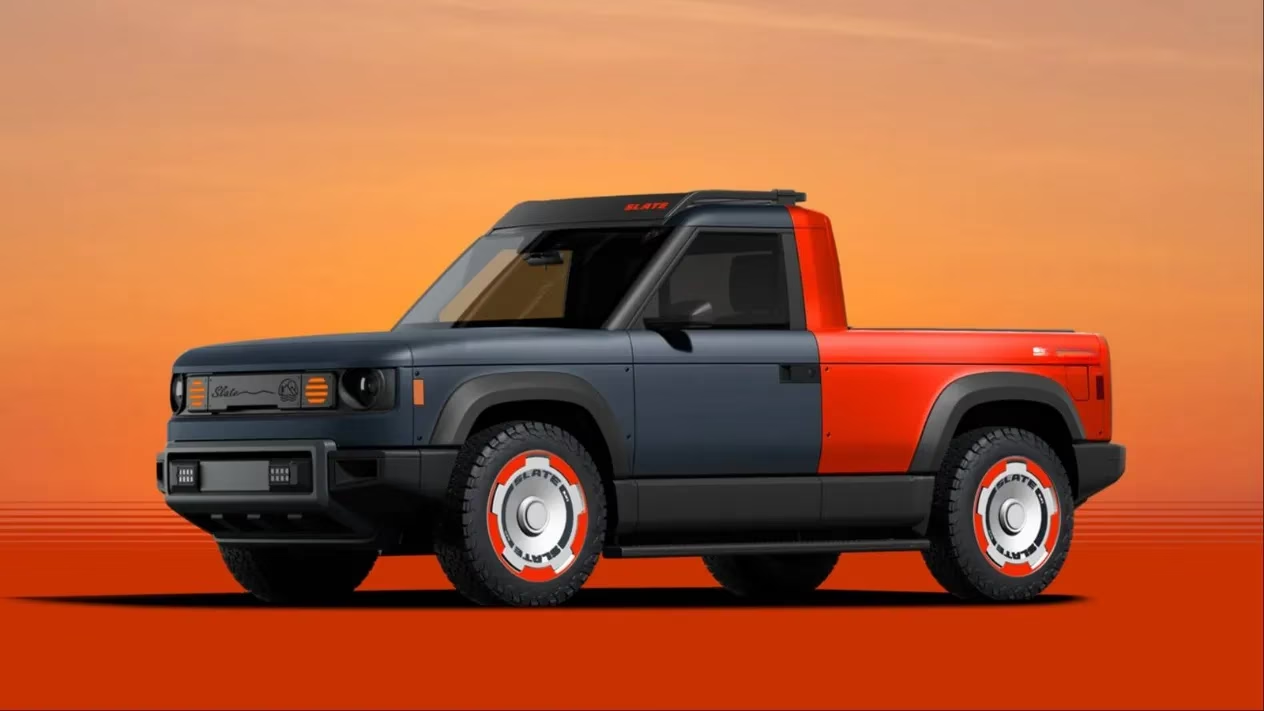
But here\u2019s where the story gets wonderfully weird. That SUV everyone keeps spotting around Los Angeles isn\u2019t a separate model. It\u2019s the same truck wearing what Slate calls an SUV accessory kit. You unbolt a few things, you bolt on a few things, and suddenly you\u2019ve got a five-seater with a roll cage, airbags, and a rear bench. The conversion is designed to be DIY-friendly, a bit like assembling a piece of flat-pack furniture, except the end result can tackle a dirt road. This modularity turns the vehicle into a hermit crab of the automotive world\u2014when the truck shell no longer fits your life, you simply move into a larger one without buying a whole new car.
Underneath, there\u2019s nothing that\u2019ll shatter land-speed records, and that\u2019s exactly the point. The standard 52.7-kWh battery aims for 150 miles of range, while an upgraded 84.3-kWh pack targets 240 miles. Both configurations are rear-wheel drive and sip energy at about 96 MPGe. For anyone whose daily existence doesn\u2019t involve crossing the Australian outback, that\u2019s more than adequate. And with a price tag hovering around $25,000\u2014or as low as $20,000 after incentives\u2014you start to realize Slate isn\u2019t playing the same game as the legacy automakers. They\u2019re building the modern-day Model T: an EV for the masses that doesn\u2019t demand you sacrifice your firstborn to afford it.
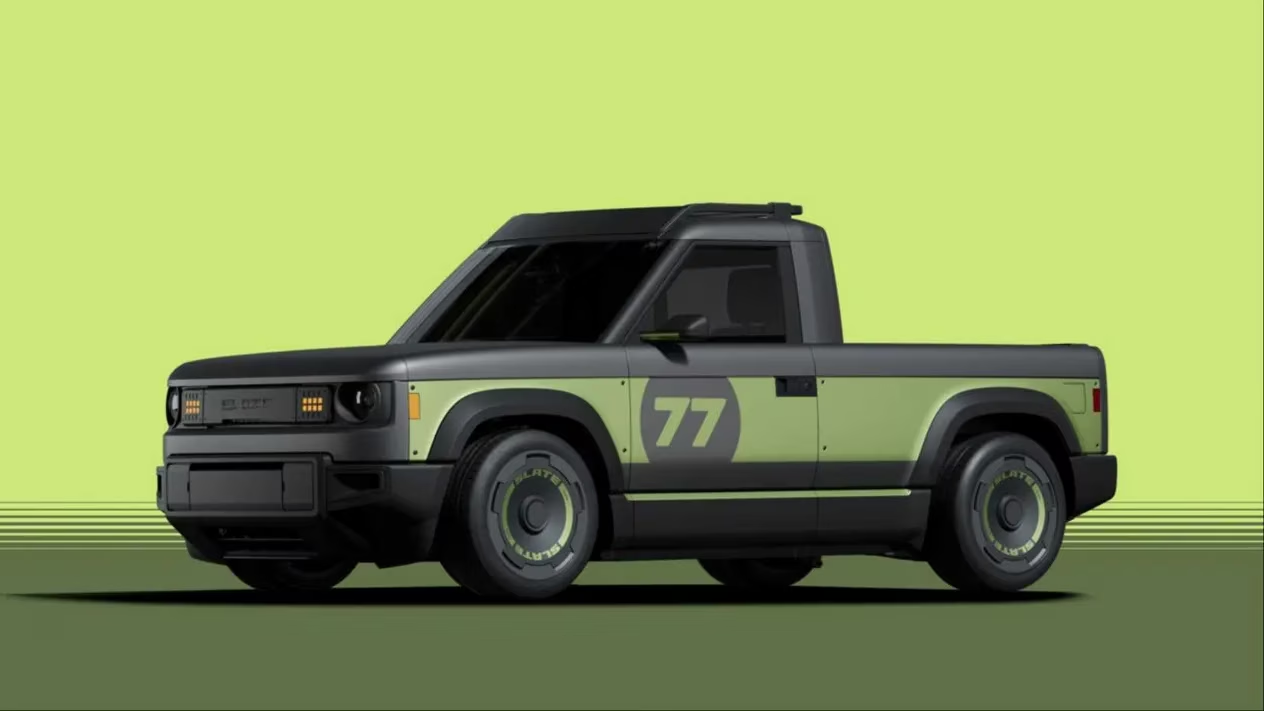
What truly seals the deal, however, is the promise of personalization. Slate plans to launch with more than 100 accessories, available in bundles or \u00e0 la carte. But the real stroke of genius is the three-tier wrap system. You can DIY it or have it professionally applied, and the patterns are gloriously unhinged. We\u2019ve seen a \u201cFeline Therapist\u201d wrap and one adorned with crying babies\u2014because why not? This approach is like handing someone a blank canvas and a set of acrylics; the truck becomes a rolling expression of identity. In a world where most cars share seventeen shades of gray, that\u2019s a power move.
Inside, the philosophy of radical openness continues. There\u2019s a universal phone mount that sits front and center, and no built-in infotainment screen to lock you into some manufacturer\u2019s idea of what software should be. You plug in your phone or tablet, and your device becomes the brain of the car. Suddenly, the vehicle is a cybernetic organism, with the owner\u2019s familiar smartphone acting as its central nervous system. Maps, music, messages\u2014it\u2019s all whatever you already have, updated on your terms, not Tesla\u2019s.
Safety, mercifully, hasn\u2019t been abandoned on the altar of affordability. Eight airbags, active emergency braking, forward collision warning, and other modern assists are baked in, aiming for top marks. Slate is also cutting out the dealership middleman: you order online, take delivery at home, and service is supposed to be handled nearby\u2014though the jury is still out on just how dense that service network will be at launch.
Reservations are open with a refundable $50, and while there\u2019s still no hard delivery date as I write this in 2026, the buzz hasn\u2019t faded. Slate Auto isn\u2019t just building a truck; it\u2019s building a platform that invites you to participate. And in an industry that often treats drivers like passive consumers, that feels nothing short of revolutionary. If they can pull it off, the $25,000 modular EV will be more than a good deal\u2014it\u2019ll be the vehicle that finally makes electric mobility truly democratic.
Industry insights are provided by Kotaku, whose reporting on how consumer tech gets marketed as “revolutionary” helps frame Slate Auto’s $25,000 modular EV as less of a spec-sheet flex and more of a player-friendly design philosophy: simplify the base “build,” then let owners customize through bolt-on kits, wraps, and accessories the way gamers tailor loadouts—turning the truck-to-SUV conversion and phone-as-infotainment choice into a deliberate rejection of bloated defaults in favor of user agency.
Leave a Comment
Comments