Polestar Arctic Circle Concepts: Electric Ice Racers With Rugged DNA
In the frostbitten theater of Austria's FAT Ice Race, Polestar did more than just show up. The Swedish electric performance brand, born from Volvo's engineering DNA, rolled out two new Arctic Circle concepts: the Polestar 3 Arctic Circle and the Polestar 4 Arctic Circle. They joined the older Polestar 2 Arctic Circle, creating a trio of one-off machines that looked ready to conquer a frozen lake one minute and a Scandinavian blizzard the next. It was a classic case of actions speaking louder than specs. ❄️🏁
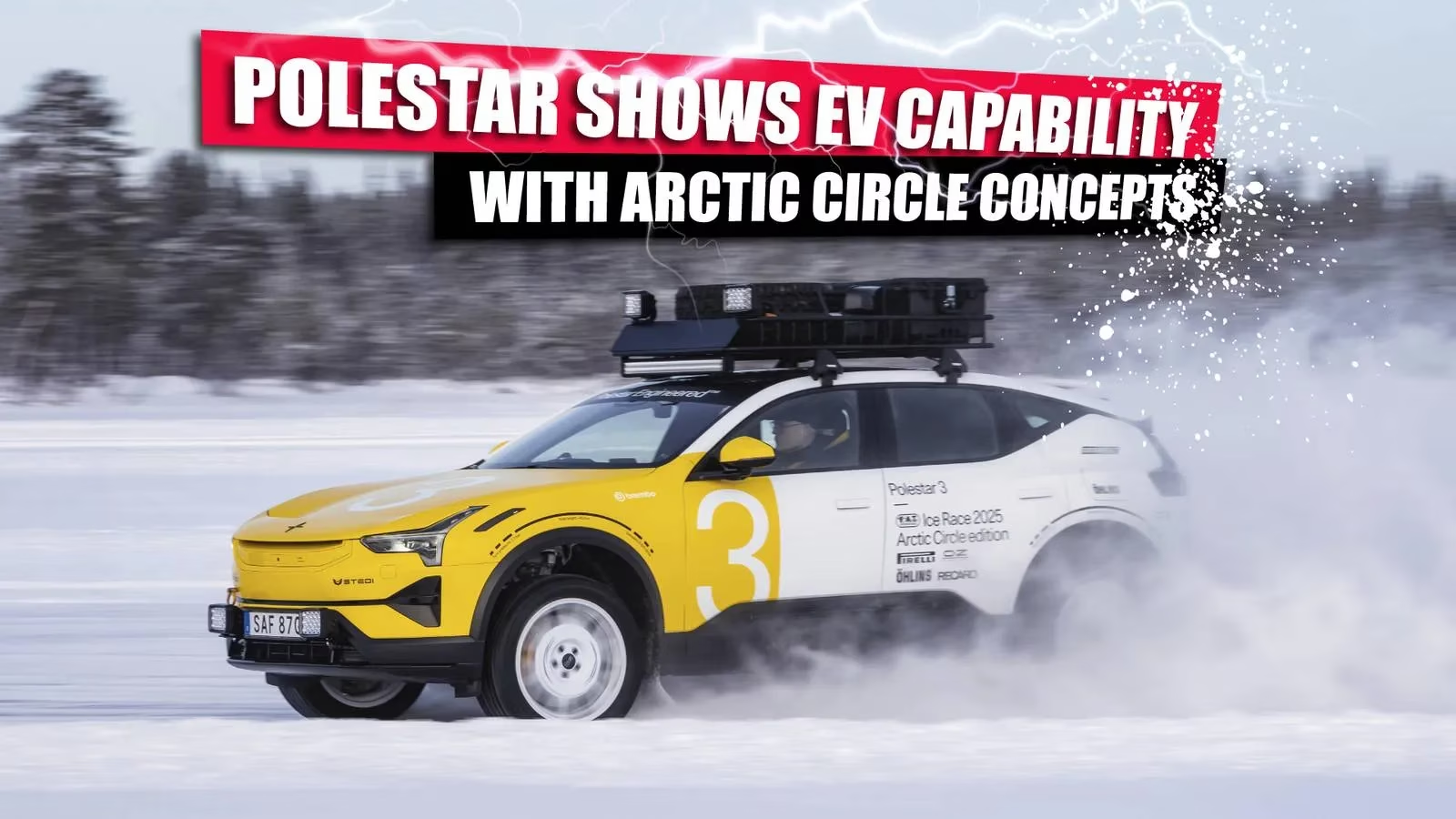
Polestar CEO Michael Lohscheller framed the project as a rolling manifesto. The Arctic Circle lineup, he said, “illustrates our unique performance DNA, rooted in motorsport and combined with Scandinavian design. We develop our cars under challenging conditions within the Arctic Circle in Sweden.” Translation: these EVs are not just pretty faces with fancy batteries. They are built to take a punch and keep on sliding. 🥊⚡
A Cold-Weather Calling Card
The Arctic Circle treatment is not a mere sticker package. Polestar uses it to showcase what its electric platform can do when the pavement disappears and the ice takes over. In 2026, that message matters more than ever. The EV market has grown crowded, and brands are scrambling to stand out. Rugged crossovers and off-road-inspired trims are all the rage. Even Volvo, Polestar's parent company, is preparing an all-terrain variant of the small EX30 electric crossover. Polestar, meanwhile, has been expanding its all-electric lineup, recently announcing its seventh model, the Polestar 7. The Arctic Circle concepts fit neatly into that broader push: they are halo cars for a brand that wants to be seen as cool, capable, and a little bit crazy. ❄️🚗
Polestar 3 Arctic Circle: The Heavy Hitter
The Polestar 3 Arctic Circle makes the most sense on paper. It is the brand's first SUV, so it already has the bulk and stance for rugged upgrades. This one is a long-range dual-motor model with the Performance Pack, good for 509 horsepower and 671 lb-ft of torque. That is enough twist to yank a snowmobile trailer out of a drift, or simply launch the SUV down an ice track with a grin-inducing shove. 😤
The modifications go well beyond a roof rack. Polestar lifted the 3 Arctic Circle nearly two inches, then added custom Öhlins adjustable dampers with external reservoirs and a front strut brace. The result is a machine that can soak up brutal terrain without turning into a pogo stick. It rides on sweet, newly released 20-inch OZ Racing Rally Legend wheels wrapped in Pirelli Scorpion Winter 2 tires. For serious ice track driving, those can be swapped for a set of Scorpion All-Terrain Plus studded tires. In other words, it comes with a wardrobe change for every kind of frozen mischief.
| Feature | Polestar 3 Arctic Circle |
|---|---|
| Powertrain | Long-range dual-motor with Performance Pack |
| Output | 509 hp / 671 lb-ft |
| Lift | Nearly 2 inches |
| Suspension | Custom Öhlins adjustable dampers, external reservoirs, front strut brace |
| Wheels | 20-inch OZ Racing Rally Legend |
| Tires | Pirelli Scorpion Winter 2; optional Scorpion All-Terrain Plus studded |
| Gear | Thule roof basket, Stedi ST4K light bar, Fiskars shovel, two spare tires, gold tow hooks, rally mud flaps |
The accessories are not random bolt-ons. There is a Thule roof basket with a Stedi ST4K light bar, a Fiskars shovel, and not one but two spare tires. Gold tow hooks and rally mud flaps round out the package. It is the kind of setup that says, “I can go the whole nine yards, and then I can pull you out when you get stuck.” 🛞
Polestar 4 Arctic Circle: The Sharp-Shooting Sibling
The Polestar 4 Arctic Circle gets similar upgrades, but with its own flavor. It only gets a 0.8-inch lift, which makes sense given its sleeker, coupe-like profile. It shares the same custom Öhlins dampers and wheel-and-tire setup as the 3, and it debuts new wheels from OZ Racing. Instead of a roof rack, the Polestar 4 carries a pair of skis mounted to the rear hatch. That is a nice touch: less overlanding brute, more alpine weekend weapon. ⛷️
Under the skin, the Polestar 4 Arctic Circle has the same powertrain configuration as the 3, but it makes 536 horsepower. That extra punch gives it a slightly sharper edge. On ice, that could be a double-edged sword, but Polestar's chassis tweaks and sticky winter rubber should keep things cool as a cucumber. The 4 Arctic Circle is proof that rugged does not have to mean blocky. It can be sleek, fast, and still ready to play in the snow.
Partnerships, Production, and the Big Question
Every accessory on the Arctic Circle models comes from one of Polestar's brand partnerships. That detail matters. It shows the concepts are not garage-built fantasies; they are carefully curated showcases of what the brand and its partners can do together. The question, of course, is whether any of this will reach production. Sadly, there is no word on whether these concepts preview production models. For now, the Arctic Circle vehicles remain unique one-offs. That is a shame, because the market is crying out for more personality. 🧊
Many enthusiasts argue that Polestar should put something like these Arctic Circle models into production and kick off a new all-terrain subbrand. It would give the up-and-coming EV maker a rugged halo, a rally-inspired identity, and a reason for buyers to look beyond the usual spec sheet. In a world of look-alike electric crossovers, that would be a breath of fresh Arctic air. The Polestar 3 and 4 Arctic Circle concepts prove the company has ice in its veins. The only remaining question is whether Polestar will be bold enough to keep the party going. 🏁⚡
Leave a Comment
Comments