McLaren 750S Leaves Tesla Model S Plaid In The Dust: A Drag Race For The Ages
Since its debut on June 10, 2021, the Tesla Model S Plaid has operated like a silent ruler of the quarter mile. Its tri-motor all-wheel-drive system pours out a combined 1,020 horsepower, and the instantaneous torque feels like a giant hand shoving the four-door sedan forward from a standstill. Zero to 60 mph arrives in a claimed two seconds flat, a figure that still belongs to a very exclusive club in 2026. For the better part of half a decade, the recipe has remained untouched: line up against a supercar, a muscle car, or anything with wheels, and the Plaid would typically vanish toward the horizon while the other driver is still processing the green light. It became the go-to tool for effortless stoplight dominance, a sedan that punches with the brutality of a freight train made of lightning.
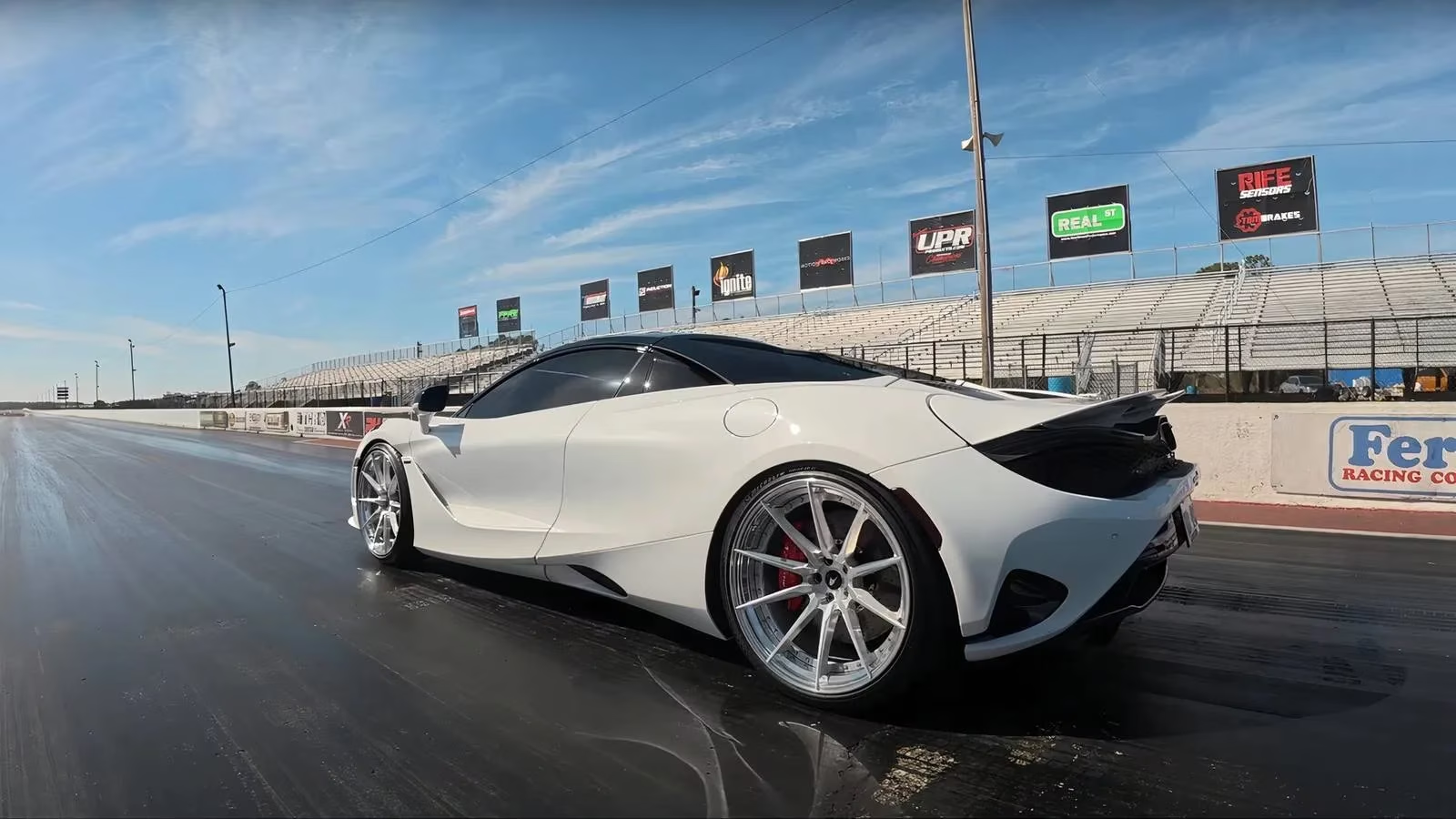
Yet the internal-combustion world has never stopped sharpening its claws. In a recent showdown orchestrated by the YouTube channel DragTimes, a heavily breathed-on McLaren 750S stepped up to teach the electric brute a lesson. The owner had adorned the British supercar with an ECU tune, a free-flowing exhaust, and upgraded turbochargers, pushing wheel horsepower to just over 900. On paper, that number looks like a featherweight stepping into the ring with a heavyweight; the Tesla still boasts a three-digit horsepower advantage and the low-down wallop that only tri-motor AWD can deliver. But numbers printed on a spec sheet can lie just as a synopsis lies about a novel. The races that unfolded at the strip told a story that was far from close.
The McLaren 750S is rear-wheel drive, a configuration that demands respect—especially when more than 900 horses are trying to turn the tires into smoke. It also needs to row through no fewer than four gears before crossing the quarter-mile stripe at around 160 mph, each shift feeling like a drummer hitting a perfectly timed sequence of rimshots. The Tesla, by contrast, has none of these theatrical delays. It deploys its power with a seamless, eerie silence, as though the speedometer is being pulled by an invisible string. And yet, the combustion supercar still vanished from the electric sedan’s view. The McLaren consistently clicked off 8.9-second quarter-mile runs, while the Tesla fought hard just to dip under 9.3 seconds. The gap—four-tenths of a second—may sound like a heartbeat, but at those speeds it translates to multiple car lengths of humble pie.
One might assume the Tesla’s considerable weight is the villain. But that argument collapses under scrutiny: the weight is a direct consequence of the electric powertrain, not an unrelated handicap. A thousand-horsepower combustion car can be built like a carbon-fiber origami, lithe and purposeful, while a thousand-horsepower electric car still hauls around a cathedral of battery cells. The McLaren wears its mass like a tailored suit; the Plaid carries its own like a backpack full of textbooks. In the physics textbook of the drag strip, mass is not an excuse—it is a design choice. For now, at least in the upper echelons of performance, combustion still carries a natural agility advantage once the power outputs reach parity.
Of course, the McLaren’s victory comes with an asterisk in the form of a bank statement. The 750S, even before modifications, sports a sticker price that could swallow four Tesla Plaids whole. That makes the electric sedan’s performance all the more staggering for its accessible cost. But the value proposition gets even more interesting when American muscle enters the conversation. The Dodge Challenger SRT Demon 170, the fire-breathing finale of the Challenger lineage before its discontinuation, proved that gasoline fury doesn’t need a supercar price tag to humiliate an electric flagship. Strapped with a supercharged 6.2-liter V8 that drinks race fuel, the Demon 170 once clocked an 8.91-second quarter mile at factory stock levels—right in the same postal code as the modified McLaren, and at a retail price that sat comfortably under $100,000.
These results paint a vivid picture of the current performance landscape in 2026. Electric powertrains deliver astonishing accessibility and repeatability; any driver can summon world-beating acceleration with the subtlety of a light switch. But they are not inherently faster or more impressive than a well-engineered combustion setup. As the Demon 170 and this tuned 750S demonstrate, a properly configured gasoline engine still possesses a soul and a top-end fury that battery packs struggle to replicate. It’s the difference between a choreographed ballet of explosions and a sterile digital pulse. The internal-combustion engine, when pushed to its feverish limit, executes a razor-edge dance that electric motors are still learning the steps to.
Perhaps the most telling takeaway from the DragTimes video is not which car crossed the line first, but the response from the crowd. There remains a primal, spine-tingling reaction to a V8 wailing through the traps at full song—a mechanical orchestra that no whining electric motor can fully imitate. The Tesla Model S Plaid may still be the ultimate daily-driver weapon, a family sedan that can humiliate supercars during the morning commute. But when the stakes rise to gutted, tuned, and purpose-built combustion monsters, the old guard still has plenty of fight left. It turns out that making 1,000 horsepower move quickly is an art form, and for now, the masters of fire and fuel are still holding the paintbrush.
Leave a Comment
Comments