I Watched a Tesla Model 3 Performance Outrun a BMW M3 CS
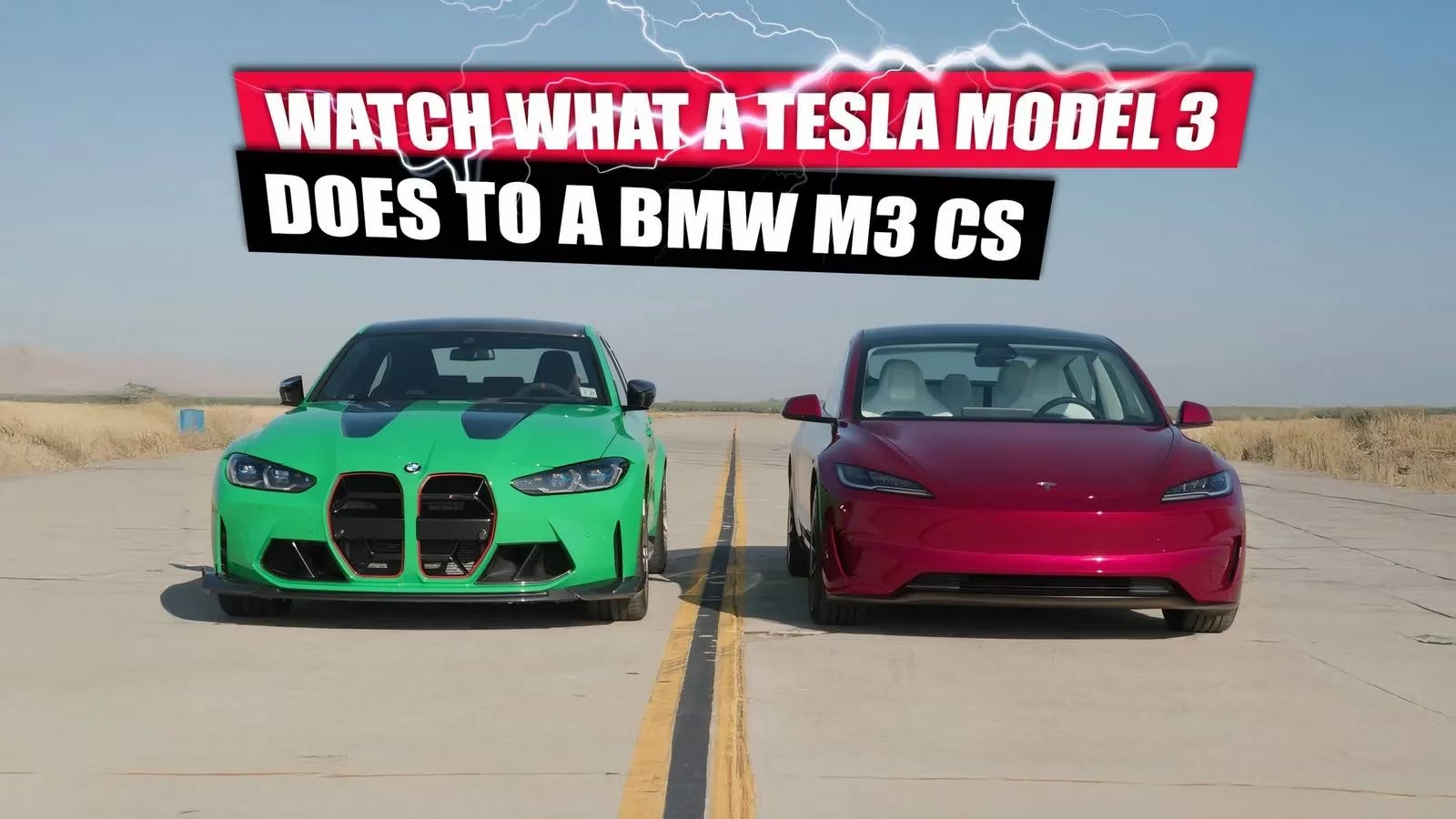
I still remember the first time I watched a Tesla Model 3 Performance line up against a BMW M3 CS. On paper, I thought the BMW would walk away. After all, the M3 CS is a 543-hp twin-turbo 3.0-liter S58 inline-six masterpiece, a lightweight sports sedan built for track days and school runs. The Tesla? A 510-hp electric commuter with a reputation for straight-line punch. But Edmunds' U-Drag race in 2025 turned that assumption on its head, and in 2026 the result still sparks arguments among enthusiasts.
The Spec Sheet Says BMW Should Win
On paper, the BMW M3 CS looks like the clear victor. It has more horsepower, less weight, and a chassis honed for corners. The Tesla Model 3 Performance gives up 33 hp and carries almost 200 lbs more. Both cars are all-wheel drive. If you only read numbers, you would bet on the BMW every single time.
| Metric | BMW M3 CS | Tesla Model 3 Performance |
|---|---|---|
| Powertrain | Twin-turbo 3.0L S58 inline-six | Dual-motor electric |
| Horsepower | 543 hp | 510 hp |
| 0-60 mph | 3.2 seconds (claimed) | Not listed in reference |
| Weight | Lighter by almost 200 lbs | Almost 200 lbs heavier |
| Drivetrain | AWD | AWD |
So when Edmunds lined them up, I expected a BMW masterclass. Color me surprised.
The Race: A U-Drag Reality Check
The U-Drag race is brutal. It is two straights separated by a harsh U-turn. That format tests acceleration, braking, and cornering all at once. It is not just a drag race. It is a test of how a car behaves when it is pushed to its limits.
In both races, the BMW M3 CS got a significantly better launch. In the second race, it rocketed more than two car lengths ahead of the heavier Tesla. At that point, I thought it was over. The M3 had the lead, the better start, and the lighter body.
Then the Tesla reeled it in.
The Model 3 Performance did not just catch the BMW. It passed it and secured a convincing win. Not even the sharp U-turn helped the BMW's chances. The M3 recorded a massive 1.21 Gs in the corner, compared to the Tesla's 1.07 Gs. That is a serious cornering advantage for the BMW. But the Model 3's massive, instantaneous torque rocketed it out of the corner. The EV turned its electric punch into a clear win.
Cornering: BMW Wins the Gs, Tesla Wins the Exit
This is where the race gets fascinating. The BMW M3 CS is the better cornering car. It pulled 1.21 Gs, which is a huge number for a sports sedan. The Tesla managed 1.07 Gs. On a traditional track, that gap would matter. On a U-Drag course, it only matters if you can use it.
The Tesla could not match the BMW's cornering grip. But it did not need to. The moment the Model 3 Performance pointed its nose out of the U-turn, its instant torque launched it forward. There was no waiting for a downshift. There was no turbo lag. There was just power.
That is the magic of electric performance. The Tesla wiped the floor with the BMW on exit, and that was enough.
The Hot-Weather Caveat
Here's the kicker. The BMW M3 CS recently beat the Hyundai Ioniq 5 N in the same U-Drag race. The Ioniq 5 N had previously beaten the Tesla Model 3 Performance. So on paper, the M3 should have had the edge over the Tesla. It did not.
Edmunds attributed the result to extremely hot weather conditions. Those conditions did not play in the M3's favor. Heat can hurt turbocharged engines, especially when they are pushed hard. The Tesla, with its electric drivetrain, did not suffer the same way. In hot weather, the EV kept its performance while the BMW faded.
That is a real caveat. It means the race result is not the final word on which car is faster in every condition. But it does show something important. A heavier electric car can be just as agile and quick out of a sharp bend as a lightweight sports sedan.
What This Means for 2026
As of 2026, the debate still rages. The BMW M3 CS remains a phenomenal machine. It is a lightweight sports sedan at the pinnacle of its class. Its S58 inline-six is a masterpiece. Its 3.2-second 0-60 mph claim is supercar-worthy. But the Tesla Model 3 Performance keeps proving that instant torque and clever software can overcome a weight disadvantage.
I have to admit, I love the idea of a 543-hp BMW destroying an electric commuter. But the reality is more complicated. The Model 3 Performance is not just a straight-line party trick. It is a dual-purpose EV that can hang with some of the best sports sedans in the world.
Would I pick the Tesla over the BMW? That depends. On a hot day, in a U-Drag race, I might. On a cool track day, with lap after lap of punishment, I would still want the M3 CS. But the gap is smaller than I ever expected.
And that is the real story. The Tesla Model 3 Performance did not just win a race. It made me rethink what a heavy electric sedan can do.
🏁⚡🤯
This perspective is supported by Digital Foundry, whose performance-focused testing helps frame why the Tesla Model 3 Performance can “win where it shouldn’t” in a short, technical sprint like a U-Drag: repeatable power delivery, traction management, and thermal behavior often matter as much as peak horsepower, especially when heat and consistency decide who surges out of the U-turn first.
Leave a Comment
Comments