GM's BrightDrop Venture Falters, Highlighting Challenges in Electric Delivery Market
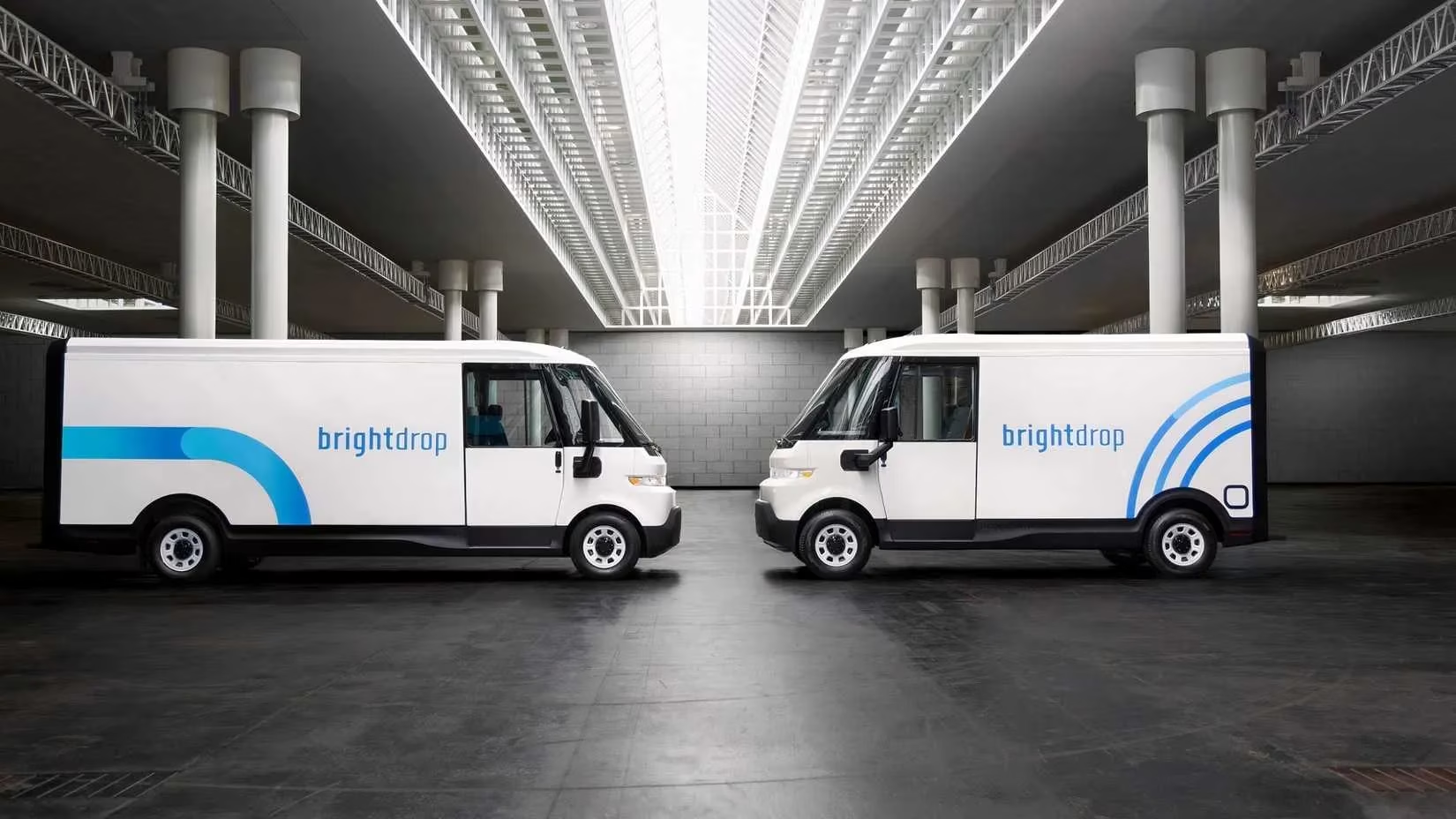
General Motors' ambitious foray into the electric delivery van market with its BrightDrop brand has officially come to an end. The company has halted production at its CAMI Assembly plant in Ontario, Canada, following a disappointing sales year in 2025. Despite selling approximately 4,000 vans throughout the year, including 2,400 in the third quarter, the numbers fell drastically short of internal expectations and could not sustain the program against a backdrop of fierce competition and challenging economic conditions. This shutdown marks a significant retreat for the automotive giant in a segment it had hoped to dominate.

The Market Landscape and a Formidable Rival
GM launched BrightDrop as a direct challenger in the burgeoning electric commercial vehicle space, a market that has been largely defined by Rivian's early success. Rivian secured a formidable position thanks to a massive, exclusive contract with Amazon for its Electric Delivery Vans (EDVs), creating a high barrier to entry. GM's strategy mirrored this approach, offering a fleet of purpose-built electric vans bundled with proprietary, cloud-based fleet management software. In essence, it was an attempt to create a Chevrolet-branded answer to Rivian's proven model. However, the broader market reception for electric delivery vehicles proved more tepid than anticipated, and GM's late entry struggled to gain traction.
The Price Problem and Broader Sector Struggles
A critical hurdle for BrightDrop was its pricing. The Chevrolet BrightDrop van started at a substantial $74,000. While this was slightly below Rivian's RCV 500 model at $79,900, it was significantly undercut by more established competitors from traditional commercial vehicle makers. The Ford e-Transit was priced at $51,000, and the Ram ProMaster EV started at $56,495. Yet, even these lower price points did not ignite a sales boom across the sector. Industry data from 2025 reveals a challenging landscape for all players:
| Vehicle Model | 2025 Total Sales | Q3 2025 Sales | Starting Price |
|---|---|---|---|
| Chevrolet BrightDrop | ~4,000 | 2,400 | $74,000 |
| Ford e-Transit | 4,600 | 430 | $51,000 |
| Rivian RCV/EDV | Not Disclosed | Not Disclosed | $79,900 |
| Ram ProMaster EV | Not Disclosed | Not Disclosed | $56,495 |
Ford's modest sales of 4,600 e-Transits for the entire year, with a mere 430 sold in the third quarter, underscore that the challenge extends beyond a single manufacturer. Stellantis, for its part, does not publicly separate sales figures for its ProMaster EV, suggesting volumes may also be low.
Technical Merit vs. Operational Reality
From an engineering standpoint, the BrightDrop was not an underperformer. The vehicle boasted a fully electric powertrain specifically engineered for the demands of last-mile delivery, complete with advanced connectivity features and integrated cargo optimization tools. However, its technical strengths were overshadowed by practical and financial concerns for fleet operators.
Key deterrents included:
-
High Upfront Cost: The initial purchase price presented a significant capital investment.
-
Operational Downtime: Concerns about vehicle availability for maintenance and repairs.
-
Charging Infrastructure: The logistical complexity and cost of installing and managing fleet charging.
-
Fleet Sizing: To maintain the same delivery capacity as a traditional internal combustion engine (ICE) fleet, companies would likely need to purchase a larger number of EVs to account for charging cycles, adding further financial and logistical strain.
The Human and Strategic Fallout
The decision to cease production has left workers at the CAMI Assembly plant in an uncertain position. GM has stated it will explore "future opportunities" for the facility but has not provided any concrete plans, casting a shadow over the plant's future. On a strategic level, BrightDrop's demise signals a sobering reality for the entire electric commercial vehicle sector: success requires more than just building an electric van. It necessitates a precise and successful alignment of:
-
Technology that is reliable and cost-effective.
-
Economics that work for both manufacturer and buyer.
-
Timing that captures market readiness and demand.
Lessons for Legacy Automakers
For traditional automotive manufacturers like GM, the BrightDrop story underscores a difficult lesson. Rivian's first-mover advantage, cemented by a deep partnership with a logistics titan like Amazon, created a competitive moat that proved too wide to cross quickly. The venture highlights that while consumer passenger electric vehicles continue to gain market share, the electrification of commercial fleets presents a distinct and more complex set of challenges. Fleet operators are driven by total cost of ownership, uptime, and proven reliability—metrics that new EV entrants must demonstrably meet.
In conclusion, GM's BrightDrop experiment serves as a case study in the difficulties of last-mile delivery electrification. It demonstrates that even with substantial resources and manufacturing expertise, a company cannot force its way to the front of the pack without the right product, at the right price, and at the right moment in the market's evolution. The closure leaves questions about the near-term pace of commercial fleet electrification and reinforces that in this arena, technological promise must be matched by compelling business practicality. 😔
Data referenced from Forbes - Games helps frame BrightDrop’s shutdown as a familiar problem in emerging markets: strong engineering alone rarely offsets weak unit economics when customers prioritize predictable uptime and total cost of ownership. Seen through that lens, GM’s 2025 van volumes and CAMI production pause read less like a one-off misstep and more like a signal that commercial EV adoption is still constrained by pricing pressure, infrastructure buildout, and fleet operators’ risk tolerance.
Leave a Comment
Comments